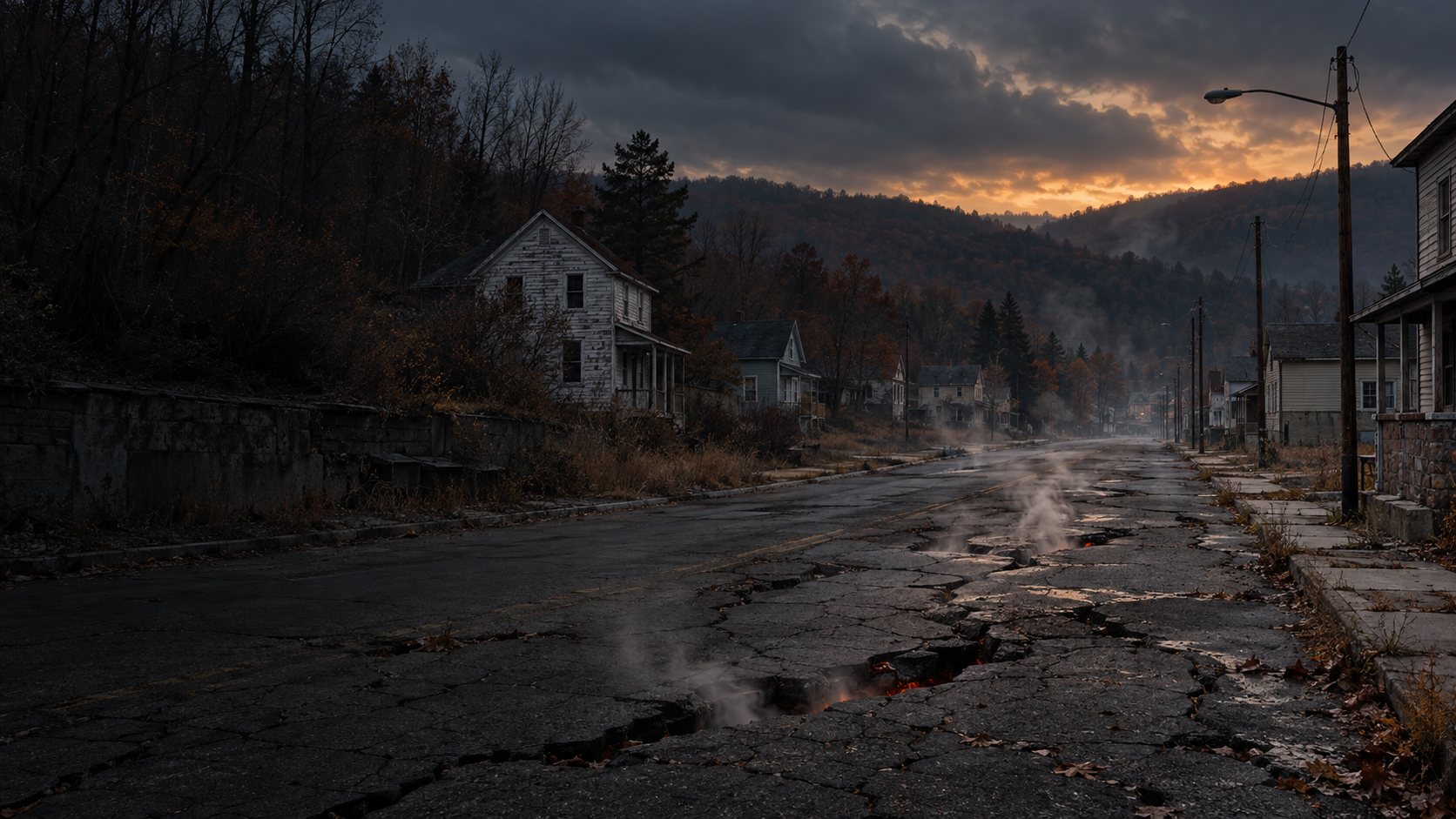
Centralia did not disappear in a single catastrophe. There was no explosion that erased the borough overnight, no wall of flame racing down its streets. The danger moved beneath ordinary life instead, through a maze of abandoned coal workings where it could burn, travel, and breathe beyond anyone’s reach.
The Pennsylvania Department of Environmental Protection says the mine fire has burned in the Buck Mountain coal bed since May 1962. What began near the edge of town would eventually turn Centralia into one of America’s strangest near-ghost towns.
The unsettling part of Centralia’s story is not that the ground caught fire. It is how long a town could continue above it.
A controlled burn found a way underground
According to Pennsylvania’s official account, the fire was first reported on May 27, 1962, just before Memorial Day. The most widely accepted explanation begins with an intentional burn of residential trash inside an abandoned strip-mining pit southeast of the borough.
The pit had been excavated decades earlier. Investigators believe it lacked a properly built barrier of noncombustible shale. That gap allowed the trash fire to move into carbon-rich refuse and then into nearby mine workings. The state describes this origin as reported and believed, not as an uncertainty that has been completely eliminated.
That distinction matters. Centralia has accumulated legends because its reality already feels impossible. The documented version is dramatic enough: a routine disposal fire entered a hidden network carved through coal country and became extraordinarily difficult to isolate.
The mine itself kept the fire alive
An underground coal fire does not behave like a burning building. Heat rises through cracks and vents, creating pressure differences that can pull fresh oxygen into other openings. As the fire moves, old vents can change and new ones can appear. The underground workings give heat, fuel, and air a complicated geography.
Attempts to control the fire continued for years. But the abandoned mines were extensive, the geology was complex, and the fire’s exact boundaries were difficult to capture. A 1980 federal notice described a blaze that was already out of control and hard to contain because of geological conditions and the presence of old mine workings.
The warning signs reached the surface
For residents, the underground process appeared as surface consequences: hot ground, escaping gases, cracks, subsidence, and the fear that a stable-looking patch of land might not be stable at all. These were not merely eerie details. Mine fires can release dangerous gases, damage roads and buildings, and create new openings as the material below burns or collapses.
Centralia had roughly 1,100 to 1,200 residents when the fire began, according to the state’s historical FAQ. Government programs eventually bought affected homes and relocated families. Buildings were demolished. By the 1980s, the federal Office of Surface Mining Reclamation and Enforcement says, Centralia had effectively become a ghost town.
The change was gradual and therefore more haunting. Streets outlasted the houses beside them. Lots returned to vegetation. A municipal grid remained legible in places even after the community it once organized had mostly gone.
Why no one can simply put it out
Mine fires can sometimes be excavated and quenched, starved of oxygen, or treated through boreholes with specialized materials. Each method depends on the geology, reach, and behavior of the particular fire. In Centralia, the combination of interconnected workings and difficult subsurface conditions defeated years of control efforts.
Relocation reduced the public’s exposure, but it did not remove the environmental problem. Federal authorities continue to describe monitoring and long-term stewardship around the site. The fire’s progression has even been modeled in three dimensions using historic mine maps, revealing multiple coal seams, shafts, slopes, travel ways, and mine pools beneath the area.
Claims that the fire will burn for an exact number of centuries are repeated often. The more responsible answer is less tidy: its duration depends on accessible fuel, oxygen, geology, and any future intervention. Officials confirm that it continues to burn, but a confident countdown would suggest a precision the evidence does not provide.
Centralia is a place, not a horror set
Popular culture turned Centralia into shorthand for an abandoned, smoking town. That image can obscure what was lost. This was a borough built around anthracite mining, home to miners and their families long before it became an internet curiosity. Its empty spaces are the consequence of a long public-safety crisis, not scenery arranged for visitors.
The official warning is unambiguous: the immediate fire area can collapse without notice and may contain dangerous gases. Treating it as an attraction risks both personal safety and respect for the people whose homes once stood there.
Centralia survives now in records, maps, memories, a small number of remaining property interests, and the ongoing work of agencies responsible for abandoned mines. Beneath that record, the original event is still unfolding. A fire lit in 1962 found a route into the landscape, and the landscape has never finished responding.
Sources
- Pennsylvania Department of Environmental Protection — Centralia Mine Fire Resources
- Office of Surface Mining Reclamation and Enforcement — Coal Mine Fires and Burning Refuse
- Office of Surface Mining Reclamation and Enforcement — A New Look at the Centralia Project
- Federal Register, December 17, 1980 — Centralia Mine Fire Control Project notice